
Sultans Trail essentials
webshop
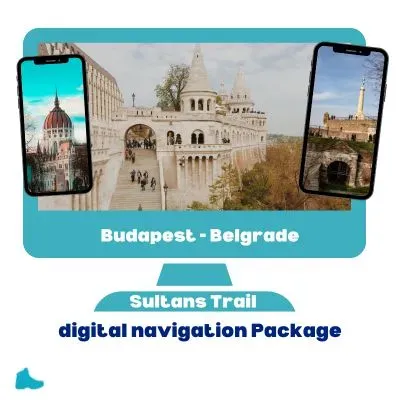
Hiking, Budapest - Belgrade digital information package.
Digital navigation packages Budapest - Mohacs - Belgrade
The material is included in the following folders:
• Points of Interest, containing GPX of KML files with: o Accommodation o Campsites o Information points o Sights o Transportation; airports, train stations, bus stops and stations o Waypoints Further information about these points can be found in the described in the Trail Description documents. Load the files of your choice into your navigation device •
Tracks, containing GPX of KML files
Further information about these tracks can be found in the described in the Trail Description documents. Load the files of your choice into your navigation device • Trail description, containing PDF documents with additional information about tracks and points of interest.
• Travel plans, no content yet.
Section 3 of the Sultan’s Trail: Budapest to Belgrade
From Hungarian Plains to Serbian Strongholds – A Journey Through the Pannonian Basin
This section traverses the Danube’s southern bend, weaving through Hungary’s pastoral Transdanubia, the Great Plain’s horse country, and Serbia’s multicultural Vojvodina. It’s a route steeped in medieval kingdoms, Ottoman battles, and riverine wilderness, culminating in the fortress city of Belgrade.
Route Overview
- Direction: Budapest → Százhalombatta → Székesfehérvár → Kalocsa → Mohács → Novi Sad → Belgrade
- Terrain: Danube floodplains, fertile plains (Pannonian Basin), wetlands (Gemenc, Gornje Podunavlje), and low mountains (Fruška Gora).
- Key Themes:
- Hungary’s Medieval & Ottoman Legacy (Székesfehérvár, Mohács).
- Serbian Orthodoxy & Habsburg History (Fruška Gora monasteries, Novi Sad).
- Danube Ecology (wetlands, national parks).
- Cultural Crossroads (Hungarian, Serbian, Croatian, Ottoman influences).
Key Highlights
1. Budapest to Székesfehérvár (Hungary)
- Százhalombatta:
- "Hundred Tumuli": Iron Age burial mounds.
- Imre Makovecz’s "Szent István Templom": A surreal wooden church by Hungary’s famed architect.
- Lake Velence: Shallow lake with birdlife.
- Székesfehérvár:
- Medieval Hungarian royal city (coronation site for kings).
- Roman Gorsium Ruins (Tác): Major crossroads of antiquity.
2. The Great Plain & Kalocsa
- Danube Crossing at Dunaföldvár: Entering the Pannonian Plain (ancient seabed).
- Kalocsa:
- Archbishopric since 1135: Baroque cathedral, medieval library (limited access).
- Horse Culture: Ranches preserving Hungarian equestrian traditions.
- Mohács:
- 1526 Battle of Mohács: Ottoman victory that shattered Hungary (memorials, museums).
3. Into Serbia: Vojvodina’s Mosaic
- Ethnic Diversity: Hungarian villages, Serbian/Croatian settlements (resettled post-Ottoman wars).
- Danube Wetlands:
- Gemenc Forest (HU): Floodplain forests, deer, and birdwatching.
- Gornje Podunavlje (RS): Danube-Drava confluence (UNESCO Biosphere Reserve).
- Fruška Gora Mountains:
- 17 Orthodox Monasteries: Hidden in forests, surviving Ottoman rule (e.g., Krušedol, Novo Hopovo).
- Novi Sad: 2022 European Capital of Culture; Petrovaradin Fortress.
4. Belgrade: Fortress of Empires
- Kalemegdan Citadel: Celtic, Roman, Ottoman, and Austrian layers overlooking the Danube-Sava confluence.
- Savamala District: Bohemian vibe with street art and nightlife.
Historical & Cultural Context
- Ottoman Wars:
- Mohács (1526): Hungary’s collapse; Ottoman advance into Europe.
- Vojvodina’s Depopulation/Resettlement: Serbs/Croats migrated north under Ottoman pressure.
- Habsburg & Orthodox Legacy:
- Fruška Gora’s monasteries as spiritual bastions.
- Novi Sad’s Austro-Hungarian architecture.
Navigation & Logistics
- Tracks: Red (GPS in Digital Information Package).
- Waypoints: Blue.
- Points of Interest: Bold in guides.
- Challenges:
- Wetland trails (Gemenc can flood).
- Border crossing Hungary-Serbia (Mohács/Bački Breg).
Why Walk This Section?
✅ Living History: From Hungarian horsemen to Serbian monks.
✅ Wild Danube: Wetlands, forests, and riverine biodiversity.
✅ Architectural Gems: Makovecz’s church, Baroque Kalocsa, Petrovaradin Fortress.
✅ Cultural Fusion: Hungarian paprika, Serbian rakija, Ottoman relics.
Tip: Time your visit for spring (wildflowers) or autumn (mild temps)—avoid summer heat on the plains.
Detour Suggestions
- Pécs (HU): Ottoman mosques and Roman tombs (slightly off-route).
- Sremski Karlovci (RS): Baroque wine town in Fruška Gora.